
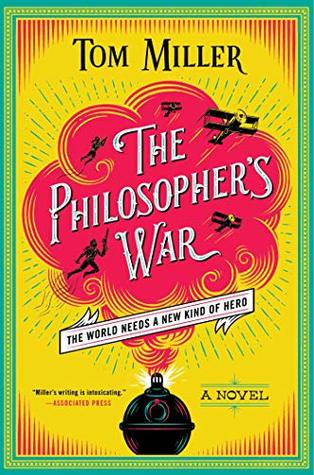
The Philosopher’s War is the second novel in a series by Tom Miller. If you haven’t read the first one, I’d go check it out now. Obviously, this review will have some spoilers for the first novel. So read at your own risk.
The Philosophers is a world in which magic lives – but in a different form. It’s a blend between magic and alchemy, and it’s called Philosophy. For one reason or another, women tend to be stronger in the arts. Robert is one of the rare exceptions to that rule, and he will break many more rules before he’s done.
The Philosopher’s War is a historical fantasy set during World War I. Things go a little differently, thanks to the use of Philosophy. That’s not to say that everything has changed, of course. There are still injured men who need to be rescued, and that’s where the R&E – Robert’s specialty and unit – comes in handy.
Writing
The Philosopher’s War was an intense and deeply emotional novel. Tom Miller did an excellent and respectful job of covering some of the worst elements of war, as seen from the Rescue and Evacuation side. It was intense at times because of it.
This novel showed the horrors of witnessed injuries, loss, PTSD, and survivor’s guilt. And it did it all with exceptional detail and respect. That’s a tough balance, but Tom Miller did it well here. It helps that he had the more fantastical elements to lean on to escape.
Historical fantasy is not for everyone. I get that – usually, I tend to avoid them. But there’s something so satisfying about this one. Maybe it’s the Philosophy being used, or perhaps the characters and world-building that Tom Miller brought to the table. Maybe it’s a combination of the three.
There was so much going on in this novel, so it’s no surprise that the pacing was on point. There was always something happening. Always something for Robert to do. Always something to worry about. While there may have been lulls in action, they were filled with character development and more.
Development
The Philosopher’s War had a massive set of characters. The main character (of course), his friends and family, the characters introduced in the first novel, the R&E team Robert worked with, and so many other characters. Together, they fleshed out this brutal world and made it feel real.
Of course, some parts of the world were based on real elements, which helped. Still, the character-building in this series was spectacular. Even the secondary characters felt real and alive – which made their losses all the more tragic when something happened to them (not a given, mind you, but this is a war we’re talking about).
This book is over four hundred pages long, but it went by in the blink of an eye for me. It sucked me in and wouldn’t let me go. It got in my head, and I imagine I won’t be the only one saying that. Robert’s tale just had so much going for it; it’s hard to be anything other than fully invested in it.
Conclusion
The Philosopher’s War lived up to and possibly exceeded, the expectations built by The Philosopher’s Flight. It was intense, dark, emotional, and breathtaking. It took all of the brilliant parts of fantasy and all the heartbreaking elements of real life and smashed them together.
I don’t think this series is for everyone. But for those it resonates with, I know they’ll enjoy it as much as I have. It isn’t what I’d consider an escape, though. The material is too heavy and touches too close to what happens in real life for it to ever be considered that.
This review was originally written for Word of the Nerd, but has been ported over to Quirky Cat’s Fat Stacks now that the site has shut down.
Quirky Cat’s Fat Stacks | Quirky Cat’s Comics | The Book Review Crew | Monkeys Fighting Robots | Storygraph | Bookhype | Bookstagram | Twitter | Tumblr | Reedsy



 Quirky Cat's Fat Stacks
Leave a comment